


ISO 22301 Certification for Business Continuity: How a Tech Company Built a Lean BCMS Without Documentation Overload

Key results

ISO 22301 certified in 18 months
0 nonconformities during the certification audit
40% reduction in documentation workload
50% less time spent preparing audit evidence
Summary
ISO 22301 Business Continuity Challenge: Preparing for IPO with a Scalable BCMS
A US-based tech company preparing for an Initial Public Offering (IPO) needed to strengthen its business continuity management capabilities and achieve ISO 22301 certification to demonstrate resilience and compliance with internationally recognized standards.
Beyond certification, the organization aimed to build a sustainable Business Continuity Management System (BCMS) that could evolve over time as the company grows and industry standards change.
As the organization already had established management frameworks in place, including an Information Security Management System (ISMS), a key challenge was integrating ISO 22301 requirements while building on existing governance, data, and security processes rather than creating unnecessary layers of documentation.
ISO 22301 Implementation Strategy: Building a Lean and Integrated BCMS
The organization began by putting governance at the heart of its approach. A broader steering committee, built on the organization’s existing ISMS steering committee, was established to guide ISO 22301 implementation, review progress, and maintain alignment with organizational priorities.
Rather than starting from scratch, the committee looked at what was already in place and what could be reused. Existing processes, governance structures, and information became the foundation of the BCMS, with ParaSolution bringing these elements together in one connected environment.
As implementation progressed, the committee also leveraged ParaSolution’s ISO 22301 built-in assessment questionnaires and reports, which gave the team a clearer view into its level of conformity, helping identify gaps, prioritize areas requiring attention, and track progress toward certification.
Connecting Business Impact Analysis (BIA), Risk Assessment and Business Continuity Plans
While preparing for ISO 22301 certification, another major efficiency gain came from centralizing the continuity data used across the Business Impact Analysis (BIA), Risk Assessment, and Business Continuity Plans (BCPs), allowing information to be shared and reused within one tool.
This approach allowed continuity information to be reused throughout the BCMS:
- BIA data could feed directly into continuity plans
- Critical activities and dependencies were consistently mapped, giving business unit owners visibility into how their activities affected other teams while automatically informing related teams of shared dependencies
- Continuity strategies were directly linked to BIA requirements and risk assessment outputs
- Redundant documentation was eliminated across ISO 22301 processes
ParaSolution created a continuous flow of information from impact analysis → risk assessment → continuity strategy implementation→ BCP development à Exercise and review, ensuring alignment and reducing manual effort.
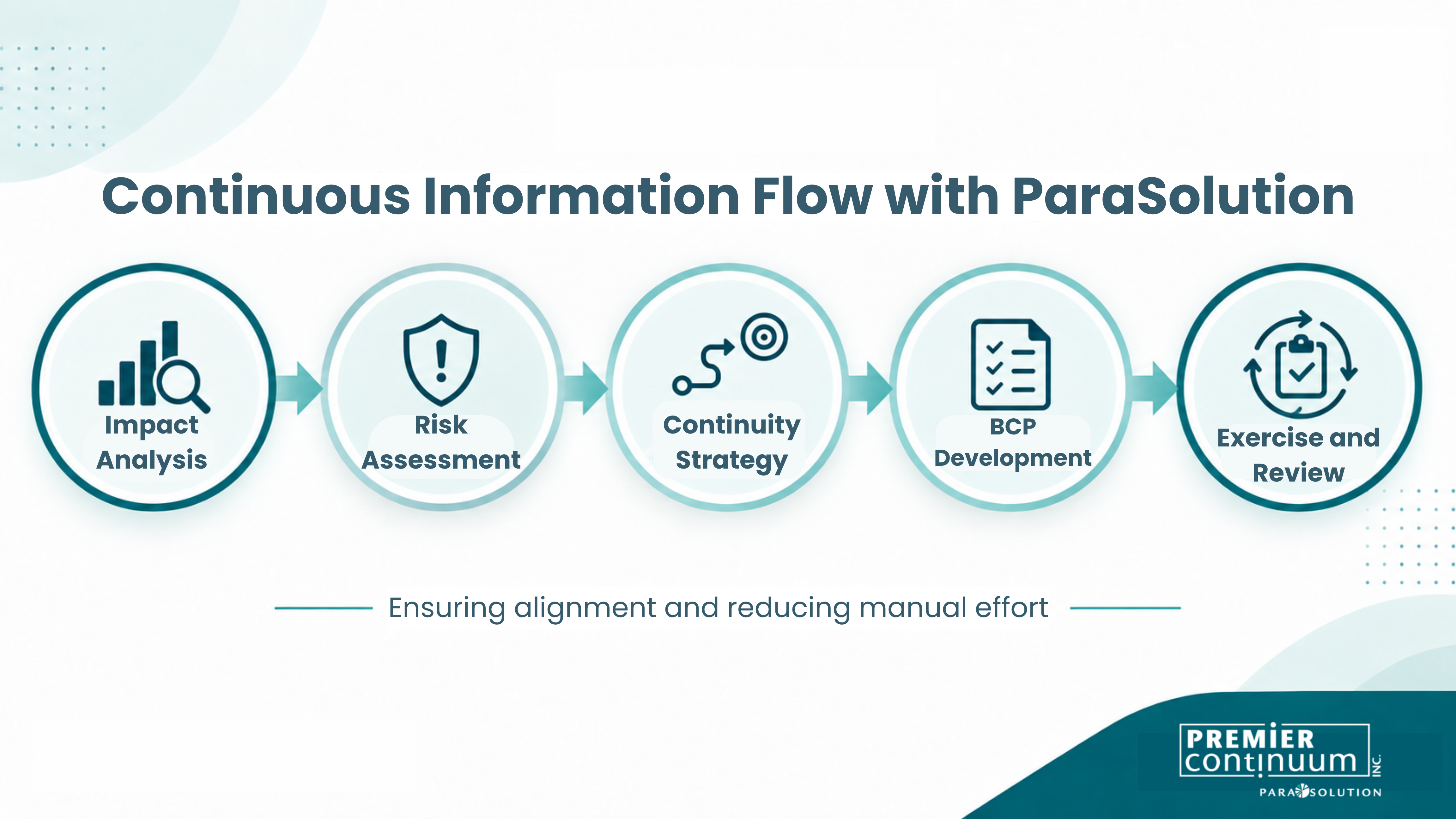
By reusing continuity information across these interconnected processes, the organization reduced its documentation workload by 40%.
Once this information was connected, the next step was ensuring that it remained accurate and up to date as the organization evolved.
Automating ISO 22301 Compliance Activities
To support ongoing ISO 22301 compliance and keep the BCMS current over time, the organization also automated key maintenance activities through ParaSolution, including:
- Imported employee and asset data
- Automated review cycles and approval workflows
- Scheduled recurring continuity plan updates
- Centralized audit-ready documentation and evidence
These capabilities ensured that business continuity information remained continuously up to date, while reducing the manual effort required to maintain ISO 22301 compliance and improving consistency and traceability across the BCMS.
The Results: ISO 22301 Certification in 18 Months with Zero Nonconformities
Within 18 months, the organization successfully achieved ISO 22301 certification for business continuity management.
The external certification audit provided clear validation of the organization’s integrated approach, with:
- 0 nonconformities during the ISO 22301 certification audit
- Strong evidence of integrated governance
- Demonstrated alignment between BCMS and ISMS frameworks
While no nonconformities were identified, the audit still highlighted areas requiring follow-up and improvement. The organization turned these findings into structured action plans and used ParaSolution’s workflow capabilities to assign responsibilities, track progress, and ensure actions were followed through to completion.
Certification validated the organization’s approach while also providing a clear path for continuous improvement beyond the audit.
Beyond Certification: Maintaining a Living BCMS
The benefits of the ISO 22301 implementation extended well beyond audit success. The organization achieved measurable improvements in the ongoing management of its BCMS, including:
- 40% reduction in documentation volume through reuse of shared data
- 95% of continuity plans continuously maintained and updated
- 50% faster audit preparation due to centralized evidence management
The organization also strengthened its overall resilience by embedding business continuity into daily operations rather than treating it as a compliance exercise.
Instead of maintaining a static set of ISO 22301 documents, the company built a living Business Continuity Management System that continuously evolves with the business. ParaSolution supports the ongoing management of the program through tools such as workflows, automated reminders, approvals, and reporting, helping the organization assign and track actions, keep information current, and continuously improve its BCMS.
Customer Perspective
For the team responsible for maintaining the program, this integrated approach also changed the day-to-day experience of managing the BCMS.
“If you want to implement and maintain a solid BCMS, you want this solution”
— IT Manager, Technology Services