From Plan Custodian to Strategic Influencer: 3 Ways to Elevate Your Role in Resilience
Discover three ways business continuity professionals can build influence, demonstrate business value, and contribute to strategic decisions.




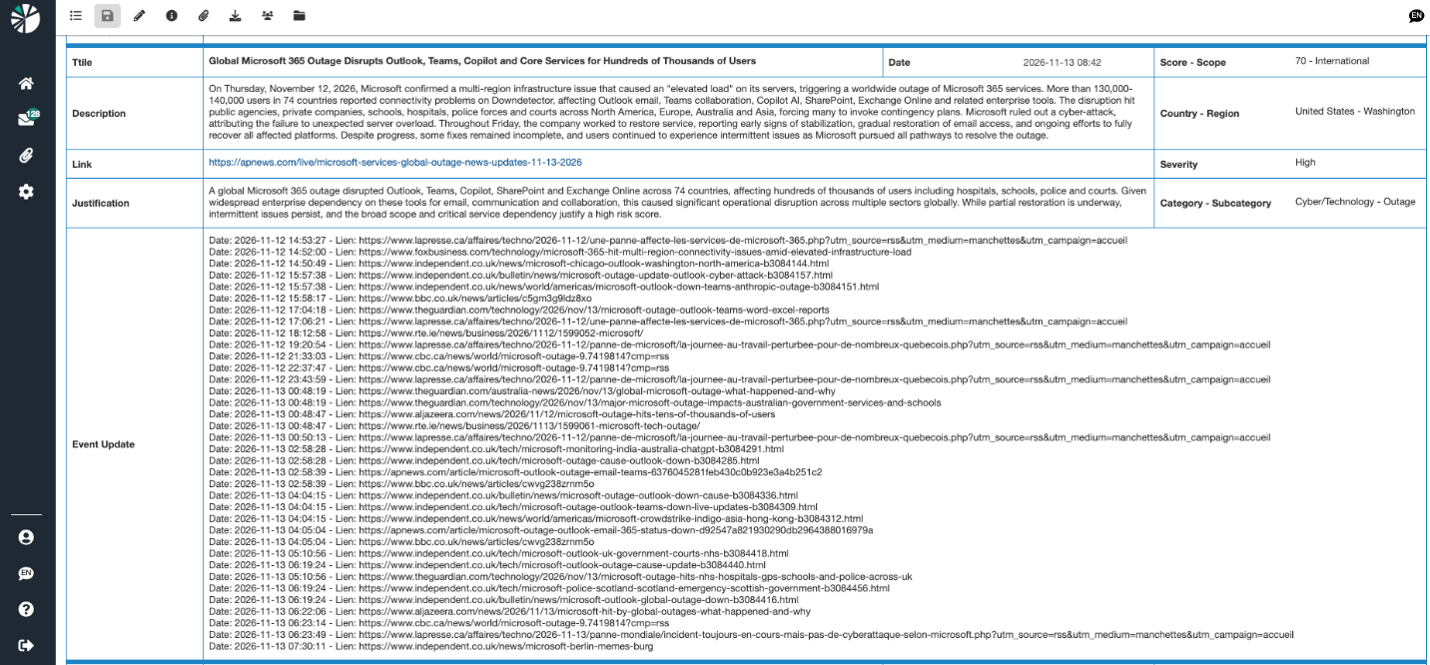
On November 12, 2026, a Microsoft 365 outage cut organizations in 74 countries and territories off from their Outlook email, and in some cases from certain Teams features, for more than 12 hours, and even longer for some. For many teams, inboxes suddenly froze. Those with a second channel were able to inform their staff quickly. The others had to improvise.
The business continuity lesson is simple: if your only way to reach employees depends on a system that becomes unavailable, your crisis communication plan collapses with it.
Marie-Hélène Primeau, CPA, MBCI, Executive Vice President of Premier Continuum, shares her expert perspective on this incident and on the importance of having the right tools to communicate in a crisis.
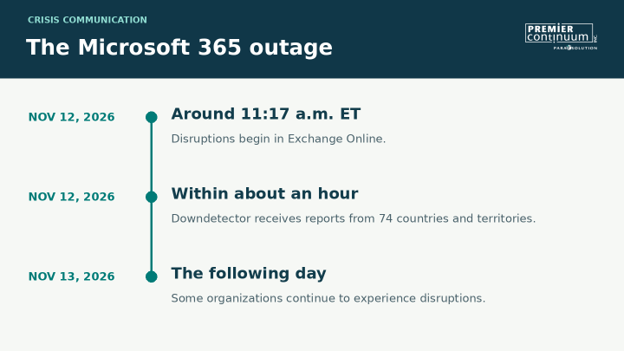
The disruption began at around 11:17 a.m. Eastern Time, according to Microsoft's incident logs. The hardest-hit service was Exchange Online, the cloud platform that manages email, calendars and contacts for business Outlook users. Features that depend on it in Teams, SharePoint and Copilot were also disrupted, while applications not tied to Exchange Online kept working. According to Downdetector, reports came in from 74 countries and territories within about an hour.
The outage carried over into the next day. Microsoft says it detected no malicious activity. The company rolled back a recent network configuration change that coincided with the start of the incident and has promised a report on the root cause once service is restored.
The impact was felt across many sectors:
With more than 430 million users according to Microsoft, a Microsoft 365 outage directly affects the way organizations work and communicate.
The disruption began at around 11:17 a.m. Eastern Time, according to Microsoft's incident logs. The hardest-hit service was Exchange Online, the cloud platform that manages email, calendars and contacts for business users. Features that depend on it in Teams, SharePoint and Copilot were also disrupted, while applications not tied to Exchange Online kept working. According to Downdetector, reports came in from 74 countries and territories within about an hour.
The outage carried over into the next day. Microsoft says it detected no malicious activity. The company rolled back a recent network configuration change that coincided with the start of the incident and has promised a report on the root cause once service is restored.
The impact was felt across many sectors:
With more than 430 million users according to Microsoft, a Microsoft 365 outage directly affects the way organizations work and communicate.
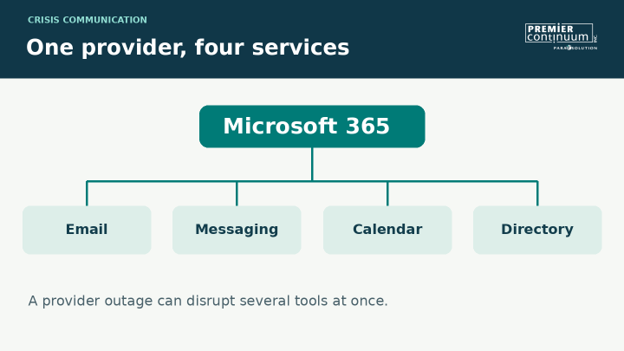
In many organizations, email, instant messaging, calendars and often the employee directory all run on a single ecosystem, such as Microsoft 365. It's a regrettable dependency: when that provider goes down, whether in Outlook, Teams or elsewhere, it isn't just one tool that disappears, but every internal channel at once.
“Many managers think an email outage only lasts a few minutes and doesn't justify investing in a backup communication solution. They're wrong. You need a clear business continuity plan built on an external notification tool. Some publicly traded companies even had to postpone their earnings releases: the impact is real, and it's costly.” — Marie-Hélène Primeau, CPA, MBCI
Three situations come up often in organizations that don't have a business continuity plan in place before a crisis:
These single points of failure often go unnoticed precisely because the tools work almost all the time.
This isn't the first time an incident tied to the Microsoft ecosystem has paralyzed organizations around the world. In July 2024, a faulty update from security vendor CrowdStrike crashed more than 8.5 million Windows devices. Philippe Tassé-Gagné drew lessons from it in our article Microsoft 2024 IT Outage: Lessons in Business Continuity.
The organizations that weather IT outages and similar service disruptions best are not necessarily those that invest the most in technological redundancy. They simply plan another route before the storm.
A few examples reported in the media:
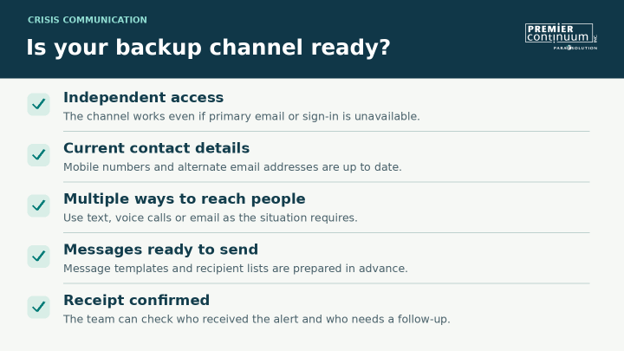
A backup communication channel is a way to reach your employees that doesn't depend on your primary tools, such as email or instant messaging. To be effective, it must remain available when those tools go down.
To assess yours, check these five criteria:
“A good backup communication channel should never depend on the infrastructure that just went down. If your email and instant messaging run on the same provider, you don't have a plan B: you have two ways to be paralyzed at the same time. This channel also needs to be tested and backed by up-to-date contact lists. Dedicated software connected to your key systems, such as your HRIS, makes keeping those lists current much easier.” — Marie-Hélène Primeau, CPA, MBCI
During the November 12 outage, email and Teams were down. Yet organizations with a mass notification system independent of Microsoft 365 could still reach their staff. This type of system sends the same message to a large number of people across several channels at once. That is one of the roles of the Crisis Management & EMNS module in ParaSolution, Premier Continuum's business continuity management software.
The Crisis Management & EMNS module lets you:
At the Ontario Ministry of the Attorney General, the outage prevented notifications from reaching the leadership team by email and Teams. The team turned to ParaSolution's text messaging feature instead.
“This outage prevented us from sending timely notifications to our leadership team via email or Teams. We used the SMS feature within ParaSolution. ( they liked it 😊) The delivery went well!” says Mohsen Kalantari, Senior Program Advisor, Emergency Management.
The Ministry was far from alone. Many of our clients also relied on ParaSolution's notification capabilities during the outage, demonstrating the importance of having reliable alternative communication channels when traditional systems become unavailable.
The November 12, 2026 Microsoft outage is a good opportunity to check how prepared you are to communicate with your employees, clients and key business partners in a crisis. Here are three actions you can take in the coming weeks:
“In a situation like November 12, an external notification system like the one ParaSolution offers lets you switch immediately to an alternative channel, such as text messages or automated calls, without losing precious minutes searching for the phone number of every employee or key partner. Teams are informed in real time of what to do, which reduces panic and, above all, limits the disruption to operations.” — Marie-Hélène Primeau, CPA, MBCI
Reaching employees during an outage is essential, but it's only a first step. Once the alert has gone out, the organization must be able to maintain its prioritized activities. And those activities don't rely on the same resources or dependencies from one department to the next. Customer service, finance, human resources and operations each have their own needs.
That is the role of the business impact analysis (BIA) and of designing continuity strategies.
For each prioritized activity, this means:
At Premier Continuum, our approach is based on the methodology of the Business Continuity Institute's (BCI) Good Practice Guidelines.
For us, an organization's strength lies in the resilience of each of its teams. Activity owners validate their own dependencies and solutions, then a consolidated analysis is used to confirm strategies across the organization. This governance keeps everything consistent. Taken together, these plans create an organization that can adapt instead of waiting for its tools to come back.
Need help mapping your dependencies or building a continuity plan for each team? Our business continuity consulting services can support you at every step.
The November 12, 2026 Microsoft 365 outage won't be the last, and no provider is immune. So the real question isn't whether your everyday applications will fail one day, but whether your organization will still be able to communicate with its teams and key contacts when they do.
The good news: a plan B is built before the crisis, and it doesn't require rethinking everything. Up-to-date contact information, a message ready to send and one exercise a year are already enough to avoid improvising and be better prepared when the time comes.
We thank Marie-Hélène Primeau, CPA, MBCI, for her valuable insights on the importance of relying on an external notification system for crisis communications.
Discover how ParaSolution helps you reach your teams, no matter which tool fails: https://www.premiercontinuum.com/parasolution