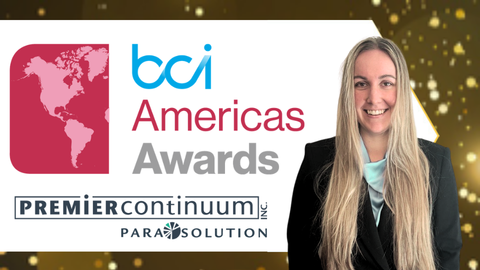
Amélie Dufresne Wins the 2026 BCI Americas Continuity and Resilience Newcomer of the Year Award!
Amélie Dufresne of Premier Continuum wins the 2026 BCI Americas Continuity and Resilience Newcomer of the Year Award. Learn more in this press release.



.png)
From cyberattacks and extreme weather events to supply chain disruptions, organizations face an increasingly complex risk environment. To help organizations prepare for, respond to and recover from these events, Canada has developed a dedicated framework: CSA Z1600.
Whether you are building a business continuity program, reviewing your emergency management capabilities or seeking to align with recognized best practices, understanding CSA Z1600 is an important step toward strengthening organizational resilience.
CSA Z1600 is Canada's national standard for emergency and continuity management program. Developed by CSA Group, it establishes the requirements for developing, implementing, evaluating, maintaining and continually improving an organization's resilience capabilities.
Originally published in 2008 and updated in 2014 and 2017, CSA Z1600 has progressively evolved from a scenario-based approach to an all-hazards and risk-based approach.
Applicable to organizations of all sizes and sectors, the CSA Z1600 standard provides an integrated framework covering four key areas:
The CSA Z1600 objective is to help organizations better anticipate disruptions, respond effectively and recover more efficiently.
The standard is built around several key components:
Together, these elements provide an integrated approach to emergency management, crisis management and business continuity.
The standard also recognizes the importance of change management and organizational resilience by considering not only people, property and the environment, but also the broader human, social, economic, cultural and political dimensions of disruptive events.
After the publication of CSA Z1600:2017, the draft CSA Z1600:2027 standard is currently open for public review until August 10, 2026.
As part of the public review process, interested individuals can review the draft standard and submit comments or suggested changes for consideration by the technical committee before the final edition is published.
Contribute to the draft standard here
No. CSA Z1600 is generally applied on a voluntary basis. However, it is widely recognized as a best-practice framework for strengthening organizational preparedness and resilience.
CSA Z1600 can be applied by organizations of all sizes and across all sectors, including private organizations, public sector organizations, municipalities, non-profit organizations, and critical infrastructure operators. Any organization seeking to strengthen its organizational resilience and continuity capabilities can benefit from applying the principles of CSA Z1600.
The CSA Z1600 and ISO 22301 standards are complementary and can be used together to build a comprehensive and mature resilience program. CSA Z1600 takes an integrated view of resilience by combining emergency management and business continuity within a single framework. ISO 22301, on the other hand, is an international standard specifically focused on business continuity management systems (BCMS). While both frameworks seek to improve organizational resilience, they approach it differently.
Whether technological, human or natural, disruptions can significantly affect operations. CSA Z1600 helps organizations become better prepared, respond more effectively and accelerate recovery. It helps adopt a risk-based and all-hazards approach to resilience, in order to better protect people, assets, operations and stakeholder confidence during disruptive events.
This article was authored by Marie-Hélène Primeau, MBCI, CPA, ISO 22301 Lead Auditor, Vice President at Premier Continuum, who also participated in the development of the 2017 and 2027 editions of the CSA Z1600 as a member of the technical committee.
At Premier Continuum, we are proud to contribute not only to the implementation of resilience standards, but also to their evolution.
If you would like to better understand the requirements of CSA Z1600, assess its implications for your organization or explore how it complements frameworks such as ISO 22301, our team would be pleased to help. Contact us.