ParaSolution Recognized as a High Performer on G2 for Business Continuity Management Software
ParaSolution is recognized as a High Performer on G2 for Business Continuity Management Software. Learn more on ParaSolution's performances on G2.



.png)
An increasing number of organizations now have a business continuity plan (BCP) aligned with the ISO 22301 standard. Yet, when a real incident occurs, improvisation remains frequent: unclear roles, slow decisions, difficult coordination.
This observation raises a crucial question: is compliance with a standard sufficient to make an organization truly resilient?
This is where the training and certifications of the Business Continuity Institute (The BCI) become particularly relevant.
ISO 22301 provides a structured framework for implementing a business continuity management system (BCMS).
ISO 22301 enables the following:
ISO 22301 therefore plays a key role: it structures the organization and creates a common language around continuity.
However, the standard focuses primarily on the system, and not on the operational aspects
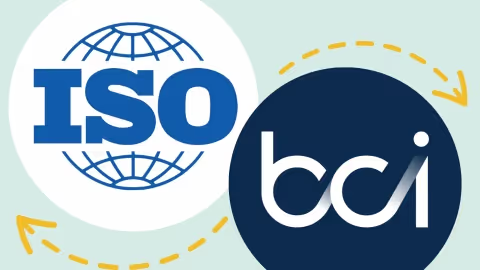
The Business Continuity Institute (BCI) takes a different and complementary approach to the ISO 22301 standard.
Its best practices framework and training programs aim to:
Where ISO answers the question: Do we have a compliant system?
BCI answers instead: Who knows what to do when an incident occurs?
In many organizations, the business continuity plan (BCP) exists AND ISO requirements are met, BUT continuity exercises remain theoretical and incident management still relies on a few key people. This is one of the most sensitive points, and one of the most closely observed on the ground.
As Marie-Hélène Primeau, Executive Vice President of Premier Continuum and a certified BCI instructor, often says:
“Continuity only truly reveals itself when it is tested, practiced, and supported by trained teams!”
For organizations, the question is therefore not one of choosing between ISO and BCI. In reality, their value is maximized when used together:
ISO structures continuity. BCI makes it operational.
We therefore invite you to discover the Business Continuity Institute's (BCI) certification programs.
Since 2008, the Business Continuity Institute (BCI) has partnered with a recognized French-speaking training provider, Premier Continuum, to offer courses aligned with its international best practices.
Starting in 2026, this expertise will be made available to professionals in French-speaking Europe through a new range of business continuity training courses.
Led by Thomas Scorticati, a certified instructor and field expert in business continuity and incident management, these courses will cover four key areas:
Learn more in the Premier Continuum press release.

As you have probably gathered, business continuity is not just about documents, audits, or certifications. It relies primarily on trained leaders who can act effectively when the situation demands it.
For organizations, as for individuals, the key question is how to combine structure and skills to build a credible and truly operational continuity plan.
BCI training programs are recognized worldwide and are specifically designed to operationalize ISO standards and other important industry standards.