ParaSolution Recognized as a High Performer on G2 for Business Continuity Management Software
ParaSolution is recognized as a High Performer on G2 for Business Continuity Management Software. Learn more on ParaSolution's performances on G2.



.png)
The issue is not strategy. On paper, resilience plans are often strong. The real challenges are execution, and especially collaboration.
In practice, resilience often succeeds (or fails!) at the team level.
According to the BCI Resilience Vision 2030 Report, 63.4% of resilience strategies fail because of the lack of cross-departmental collaboration (silo mentality), 46.1% of resilience strategies fail because they lack budget, and 44.5% because they lack management support.
As Alice Kaltenmark explained during the Premier Continuum Insights Webinar, disruptions rarely respect organizational boundaries. They cut across departments, technologies, and responsibilities.
When teams are unable to collaborate, share information, and coordinate decisions under pressure, even strong resilience programs can break down operationally.
This is why resilient organizations focus not only on governance and planning, but also on building teams that can operate effectively during disruption.
Or continue reading to explore how resilient teams improve operational coordination, communication, and decision-making under pressure.
Team resilience refers to a team’s ability to adapt, coordinate, and continue operating effectively during disruption, uncertainty, or high-pressure situations.
In the context of business continuity and organizational resilience, resilient teams are able to:
Team resilience is not only about individual performance: it is about how effectively teams work together when plans no longer perfectly apply.
Team resilience also builds upon both organizational resilience and leadership resilience by transforming strategy and governance into operational coordination.
Resilient organizations invest in:
Because ultimately, resilience becomes operational through teams.
Team resilience is not about heroism during a crisis: it is about what teams have already built before disruption occurs.

One of the main reasons resilience fails at the team level is the lack of shared awareness across functions.
Resilient teams understand how their work connects to others. People know not only their own responsibilities, but also who they depend on and who depends on them.
This shared awareness is strengthened through:
Does each team member understand not only their own responsibilities, but also how their work fits together with that of others and what the critical dependencies are?
When disruption happens, this shared awareness prevents confusion, duplication of effort, and critical gaps.
Work with Premier Continuum’s experienced consultants to build business continuity plans that improve operational visibility, strengthen coordination across teams, and support faster decision-making under pressure, using internationally recognized practices aligned with ISO 22301 and the BCI Good Practice Guidelines. Learn more on our approach here.
Many organizations build business continuity plans centrally and distribute them afterward. Resilient organizations do the opposite.
Resilient teams are not passive recipients of contingency plans; they actively participate in contingency planning before disruption occurs through:
Effective contingency planning also helps teams:
This is how resilient teams build stronger ownership, better operational alignment, and faster execution during disruption.
Because we support what we help build.
Did you know BCM software solutions such as ParaSolution help teams actively participate in contingency planning by centralizing plans, dependencies, responsibilities, and recovery strategies in a shared platform?
This strengthens:
Discover our award-winning BCM software ParaSolution.
Operational readiness is built through repetition and practice.
As we covered in our recent article on Leadership Resilience:
Training creates shared mental models, common language across teams, and confidence in uncertain situations.
This is why business continuity exercises and crisis simulations are essential components of team resilience.
Exercises help teams:
If you want to elevate the way your organization designs and delivers business continuity exercises, we highly recommend the Business Continuity Institute course Designing and Delivering Effective Exercises. Available in virtual mode, in English and in French, this 2-day training helps professionals design, facilitate, and evaluate realistic business continuity exercises that strengthen operational readiness, coordination, and decision-making under pressure.
Team resilience also depends on redundancy planning. The goal? Eliminating single points of failure.
Organizations become vulnerable when:
Resilient organizations reduce these risks through:
One of the best ways to strengthen this capability is to rely on an independent and centralized business continuity platform. When disruption occurs, teams can quickly access the right plans, responsibilities, dependencies, and recovery priorities, enabling faster coordination, clearer communication, and more confident decision-making under pressure.
Our BCM software, ParaSolution, helps organizations strengthen communication and decision-making resilience by centralizing critical operational information in one secure platform.
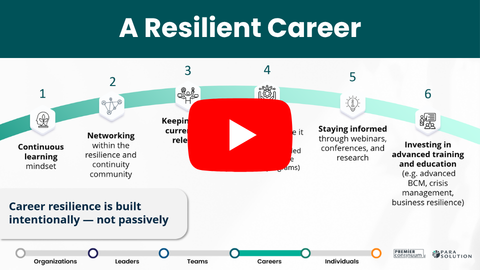
As highlighted throughout the Five Layers of Resilience, resilience becomes operational through people, not only through plans or technology.
Curious to learn more on the topic of resilience?
Watch the full webinar to learn more about the four other layers of resilience.